AI Is Automating the Work That Creates Experts
Artificial intelligence allows consulting and technology companies to complete many tasks with fewer employees.
A senior consultant supported by AI can analyse requirements, generate code, prepare documentation, review test results, and create presentations much faster than before. Work that once required several junior employees can increasingly be completed by a small number of experienced people using AI tools.
The immediate conclusion appears obvious:
Want more practical data engineering analysis like this?
Join DWHPro Letters and get field-tested notes on Teradata, Snowflake, AI, migrations, performance, and enterprise data work. DWHPro Letters is free. Subscribe to get new issues by email.
If AI performs much of the junior work, companies need fewer juniors.
From a short-term financial perspective, this conclusion is understandable.
Fewer junior employees means:
- Lower personnel costs
- Less training and supervision
- Smaller project teams
- Less time on the bench
- Higher revenue per employee
- Potentially higher profit margins
However, this calculation considers only how the next project will be delivered.
It does not consider how the company will create its next generation of senior consultants.
Junior Work Was Also a Training System
An experienced consultant does not enter the labour market as an experienced consultant.
The normal development path looks approximately like this:
Junior
→ Consultant
→ Senior Consultant
→ Manager
→ Architect, specialist, or partner
Employees move through this path by working on real projects.
At the beginning of their careers, they usually perform relatively structured tasks:
- Analysing source data
- Writing basic SQL or program code
- Testing applications
- Preparing documentation
- Reconciling results
- Investigating incidents
- Creating first versions of reports
- Supporting experienced employees
These are exactly the tasks that AI can automate most easily.
The problem is that these activities were never only inexpensive production work. They were also the environment in which junior employees learned.
A junior data engineer learns by investigating why a load process failed.
A developer learns by debugging code that behaves differently from what was expected.
A consultant learns by preparing an analysis and observing which parts survive contact with the client.
A junior auditor learns by reviewing individual transactions before being expected to judge an entire process.
The work may have looked repetitive from the outside. But it exposed the junior to thousands of small decisions, mistakes, exceptions, and unexpected situations.
This exposure gradually created judgment.
When companies automate the work, they may also remove the learning process hidden inside it.
Not Every Task Is Equally Easy to Automate
AI performs particularly well when a task has:
- Clear input
- Known rules
- A repeatable process
- A result that can be checked easily
Examples include generating standard documentation, producing basic test cases, transforming data according to fixed rules, summarising meetings, or modifying code following a well-defined pattern.
These tasks are suitable for automation.
Other tasks are different.
A production performance problem, an unusual accounting situation, or a failed data migration may require several possible explanations to be evaluated. The answer exists, but it is not immediately visible.
An experienced person may need to examine:
- Data distribution
- Workload conditions
- Previous design decisions
- Business rules
- Client-specific constraints
- Timing effects
- Dependencies on other systems
- Information that was never documented
AI can support this analysis. It can generate possibilities, search historical documents, and identify known patterns.
But someone must still decide whether the proposed explanation fits the actual environment.
This is where experience matters.
A Senior Expert Is Not a Junior Plus AI
A junior employee can ask AI to design a system architecture.
The generated result may look professional. It may contain correct terminology, standard components, and accepted design patterns.
However, an experienced architect may immediately recognise that:
- The expected data volume makes the design unsuitable.
- A proposed distribution method will create skew.
- A regulatory constraint has been ignored.
- The solution will fail during month-end processing.
- The required source data does not exist.
- A technically correct design will not be accepted by the organisation.
- A legacy component cannot be changed independently.
- The proposed operating model is unrealistic for the client.
The AI system can generate a solution from the information it receives.
Experience is required to recognise which information is missing.
This distinction is fundamental:
AI gives a junior access to answers. It does not automatically provide the experience required to evaluate those answers.
A convincing answer is not necessarily a correct answer.
A technically correct answer is not necessarily a usable answer.
A standard solution is not necessarily suitable for a specific environment.
Experienced employees understand these differences because they have seen projects fail.
Experience Cannot Be Produced by a Fixed Formula
Companies may try to replace practical junior work with courses, certifications, simulations, and AI-based training.
These tools can help. But professional experience cannot be produced through a simple formula such as:
20 training courses
+ 100 AI exercises
+ 5 certifications
= senior consultant
Two employees may work on the same projects and develop very different levels of competence.
Their development depends on:
- Which problems they encounter
- Whether they are allowed to investigate them
- Which experienced employees they work with
- Whether mistakes are explained or merely corrected
- Whether they observe production systems
- Whether they participate in difficult client discussions
- Whether they take responsibility for decisions
- Whether they understand why a solution succeeded or failed
Expertise develops through repeated interaction with uncertain situations.
It cannot be planned in every detail.
Companies can create conditions in which expertise is more likely to develop. They cannot simply order it when it is needed.
The Problem Has a Long Time Delay
Reducing junior recruitment will not create an immediate crisis.
Assume that a large consulting company significantly reduces junior hiring in 2027.
During the following years, the company may perform very well.
It still employs experienced consultants, managers, architects, and partners. These people were trained under the previous model. AI makes them more productive, so fewer juniors are required to support them.
The financial results may improve:
Fewer juniors
→ lower costs
→ smaller teams
→ higher revenue per employee
→ improved margins
Management may consider the strategy successful.
The real consequences appear later.
Senior employees retire. Others leave for clients, software vendors, smaller consultancies, or independent work. Managers move into sales roles. Architects become responsible for too many projects.
Normally, these people would be replaced by employees who joined five or ten years earlier.
But the company reduced those hiring cohorts.
The result is a missing generation.
The company may still have a small number of highly experienced specialists and a new group of AI-assisted junior employees.
What it lacks is the middle layer:
- Consultants who can deliver independently
- Managers who understand implementation details
- Architects with practical production experience
- Specialists who can recognise unusual risks
- Employees capable of developing the next group of juniors
The traditional organisational pyramid becomes an hourglass:
Experienced specialists and partners
               ↓
      insufficient middle layer
               ↓
     AI-assisted new employees
This is not primarily a headcount problem.
It is a capability problem.
Senior Employees Retire While the Pipeline Shrinks
The timing is especially dangerous because many experienced IT professionals are approaching retirement.
These employees often hold knowledge about systems that have been operating for decades.
They know:
- Why particular architectural decisions were made
- Which interfaces regularly fail
- Which tables contain unreliable data
- Which processes become unstable under peak workload
- Which official business rules are incomplete
- Which workarounds must remain in place
- Which applications cannot be changed independently
- Which people must be involved before production changes are made
Much of this knowledge is not stored in formal documentation.
Normally, it is transferred gradually while experienced and less experienced employees work together.
The junior sees how the senior investigates a problem.
The junior asks questions.
The senior explains why the obvious solution is wrong.
Later, the junior encounters a similar situation and recognises the pattern.
Knowledge transfer happens through repeated shared work.
If fewer juniors are hired, fewer people are available to receive this knowledge.
The pipeline is therefore affected at both ends:
Fewer juniors enter
+
More seniors leave
=
Loss of organisational knowledge
Documentation Is Not a Replacement for Experience
Companies may attempt to solve the problem by collecting all available information in an AI-supported knowledge platform.
This is useful.
The platform may contain:
- Source code
- Data models
- Architecture diagrams
- Operating procedures
- Business rules
- Test cases
- Incident reports
- Meeting notes
- Project decisions
- Technical manuals
AI can search this material faster than any employee.
It can summarise documents, connect related incidents, explain code, and identify similar historical problems.
But documented knowledge is only one part of professional expertise.
The most valuable knowledge often includes:
- Knowing which documentation is obsolete
- Recognising that a technically valid result looks wrong
- Understanding which workaround is still required
- Knowing how a system behaves under unusual load
- Remembering why a previous project failed
- Understanding political and organisational constraints
- Knowing when the standard solution should not be used
- Recognising which assumptions must be challenged
This knowledge is difficult to document because experienced people are often not fully aware of everything they know.
A performance expert may look at an execution plan and immediately suspect a statistics problem.
The conclusion may be based on hundreds of previous plans, production incidents, workload situations, and tuning exercises.
The expert may not be able to list every observation that contributed to the judgment.
AI can preserve what the company wrote down.
It cannot reliably preserve what the company never recognised as knowledge.
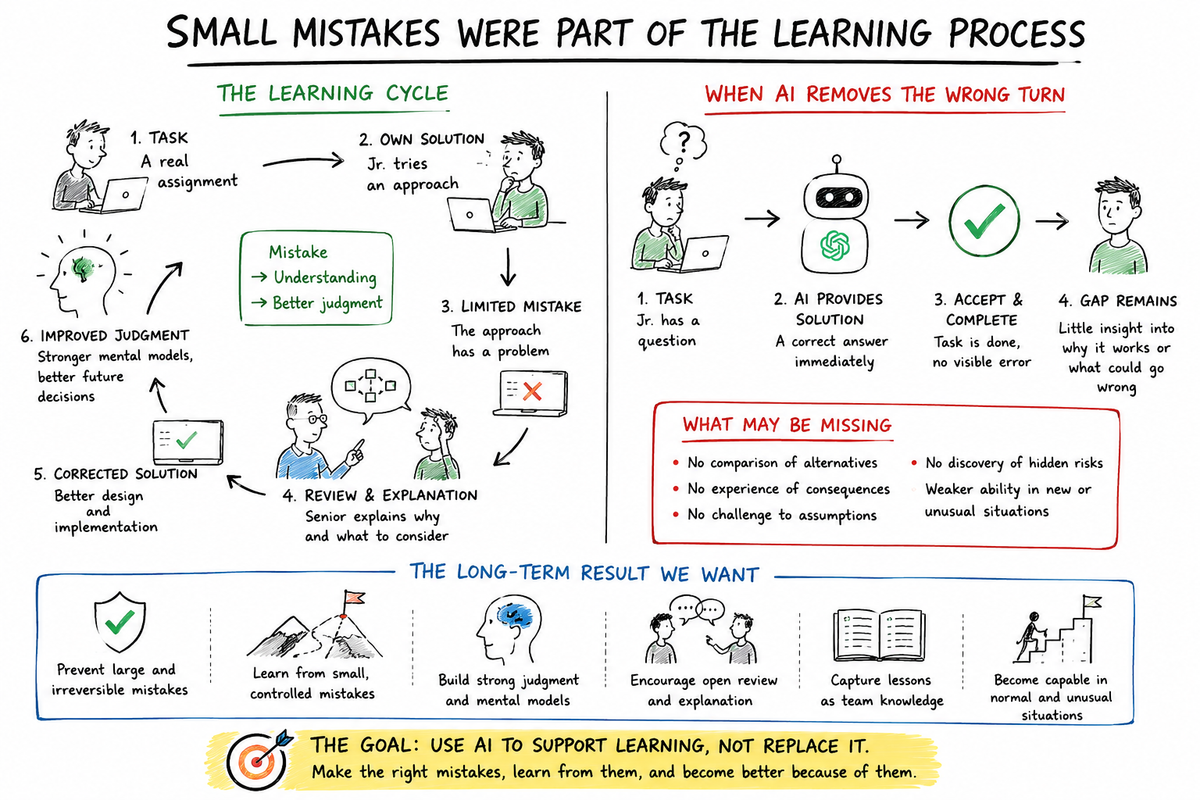
Small Mistakes Were Part of the Learning Process
A good training environment does not attempt to eliminate every mistake.
It prevents large and irreversible failures while allowing small, controlled mistakes from which employees can learn.
A junior may select the wrong design for a test environment.
A senior reviews it and explains the consequences.
The junior changes the design and observes the difference.
Later, the junior recognises the same problem in another context.
The employee and the organisation are more capable after the mistake than before it.
The process looks like this:
Small real task
→ own decision
→ limited mistake
→ experienced review
→ understanding of consequences
→ improved future judgment
AI can unintentionally remove this process.
If AI immediately produces the correct code, a plausible architecture, and complete documentation, the junior may never see the wrong alternatives.
The result is delivered faster, but the employee learns less.
This can create a dangerous pattern:
If you work with enterprise data platforms, migrations, performance tuning, or AI-driven delivery teams, DWHPro Letters is written for you. Get the next issue by email.
Fewer visible mistakes
→ fewer discussions
→ less understanding of causes
→ less practical experience
→ greater dependence on AI
The absence of errors does not necessarily mean that the organisation is learning.
It may mean that the learning process has been removed.
Efficiency Can Increase Fragility
Consider a project delivered by one senior consultant and several AI agents.
Under normal conditions, this model may be highly efficient.
The senior understands the client, validates the output, and handles the difficult decisions. The AI performs research, coding, testing, and documentation.
The project requires fewer people and may deliver better margins.
Now assume one of the following happens:
- The senior leaves the company.
- The system behaves in an unexpected way.
- The AI produces a convincing but incorrect explanation.
- A rare regulatory situation appears.
- The documentation does not match the real process.
- The client introduces a major architectural change.
The organisation may discover that its efficiency depended on one person.
What looked like the removal of unnecessary duplication was actually a concentration of risk.
Several people with overlapping knowledge are not always wasted capacity.
They provide:
- Continuity
- Different perspectives
- Mutual review
- Replacement options
- Future successors
- Protection against individual failure
Short-term efficiency often encourages companies to remove this overlap.
But the most efficient organisation under normal conditions may be the least capable organisation when conditions change.
Junior Cohorts Create Future Options
A company does not know which junior employee will become a future architect, specialist, manager, or partner.
It cannot reliably predict:
- Which person will develop rare technical expertise
- Which employee will understand a specific industry
- Who will become capable of handling difficult clients
- Which person will remain with the company
- Which new technologies will become important
- Which knowledge will become scarce ten years later
Hiring juniors is therefore not only a staffing decision.
It creates future options.
Consider a cohort of one hundred juniors:
100 juniors
→ different projects
→ different mistakes
→ different specialisations
→ several future experts
→ many future organisational options
Not every junior becomes a senior specialist.
That is not a defect in the model.
The variety is part of what makes the pipeline useful.
If the company hires only ten juniors, it saves money today. But it also reduces the number of future possibilities.
These options cannot be purchased instantly later.
A person with ten years of experience still requires ten years to develop.
The Financial Benefit Is Limited, but the Risk Is Not
The financial advantage of reducing junior hiring is relatively easy to calculate.
A company may save:
- Salaries
- Training costs
- Recruitment costs
- Bench costs
- Management effort
The maximum benefit is limited.
The potential long-term cost is more difficult to calculate:
- Missing project managers
- Loss of critical system knowledge
- Quality failures
- Regulatory mistakes
- Dependency on individual specialists
- High external contractor rates
- Lost clients
- Projects that cannot be accepted
- Major incidents that cannot be diagnosed quickly
The company receives a visible and limited benefit today in exchange for an uncertain but potentially much larger future risk.
The problem is that the benefit appears in the current financial year.
The risk may not appear for another decade.
IT May Become Less Attractive
Reduced junior hiring may also change how young people evaluate an IT career.
For many years, IT was attractive because it offered:
- Strong demand
- Good salaries
- Accessible entry-level positions
- A clear development path
- Opportunities to learn while working
- Long-term employment prospects
AI may change this proposition.
A person considering an IT career may see:
- Fewer junior positions
- More competition for each role
- Higher expectations from the first day
- Less formal training
- Continuous pressure to learn new tools
- Uncertainty about which skills will remain valuable
- Salary pressure for generic work
- Employers demanding experience while offering fewer opportunities to gain it
Some talented people may select other careers.
This can create a reinforcing cycle:
Fewer junior jobs
→ IT appears less attractive
→ fewer people enter the profession
→ smaller talent pool
→ future shortage of experienced specialists
Companies may argue that AI reduces the total number of people required.
That may be correct.
But a smaller workforce does not reduce the need for high-quality employees.
It increases the importance of each individual.
A team of twenty can absorb several weak performers.
A team of four cannot.
Salary Pressure Will Not Affect Everyone Equally
AI is unlikely to reduce all IT salaries.
It will probably divide the market.
The first group performs work that can be standardised and described precisely:
- Basic coding
- Standard testing
- Documentation
- Routine reporting
- Simple data transformations
- First-level support
- Basic technical analysis
These activities will face strong automation and price pressure.
The second group possesses knowledge that is difficult to reproduce:
- Deep industry understanding
- Knowledge of a specific client environment
- Experience with production incidents
- Understanding of complex legacy systems
- Architecture and performance expertise
- Regulatory knowledge
- Ability to make and defend difficult decisions
The market value of the first group may decline.
The market value of the second group may increase.
AI makes generic technical output abundant.
It does not make specific experience abundant.
A company may generate SQL within seconds. This does not mean it can easily find someone who understands why the query creates skew, consumes excessive spool, blocks another workload, or returns incorrect results during month-end processing.
The industry may therefore experience two phases.
First, salary pressure affects a broad range of technology roles.
Later, companies discover that genuine experts have become scarce.
They may then:
- Pay large retention bonuses
- Bring retired specialists back as contractors
- Recruit experienced employees from clients
- Acquire small specialist consultancies
- Delay projects because experts are unavailable
- Pay much higher rates for critical knowledge
The industry may reduce the number of people it employs while becoming more dependent on a much smaller number of highly paid specialists.
Big Consulting Firms Are Especially Exposed
Large consulting firms traditionally use a pyramid model.
Many junior employees perform detailed work. Managers coordinate and review it. A smaller number of partners manage client relationships and sell projects.
AI reduces the labour required at the bottom of the pyramid.
The firm may attempt to replace the old structure with:
Partner
→ small group of senior consultants
→ AI agents
This model can work while experienced consultants remain available.
It becomes unstable when those consultants retire, leave, or become responsible for too many projects.
AI agents do not become managers after five years.
They do not become partners after fifteen years.
They do not develop client trust in the same way humans do.
They do not accept legal or professional responsibility.
Most importantly, they do not solve the human succession problem.
AI Can Also Improve the Training Model
The solution is not to preserve every old junior task.
Companies should not maintain inefficient manual work only to give junior employees something to do.
The work will change.
The training model must change with it.
AI can be used to create better learning opportunities.
It can:
- Reconstruct historical incidents
- Generate several possible architectures
- Challenge a proposed solution
- Simulate unusual production failures
- Present incomplete or misleading evidence
- Compare alternative root-cause analyses
- Explain the consequences of different decisions
- Allow juniors to practise rare situations safely
The difference lies in how the tool is used.
A weak learning process looks like this:
AI generates answer
→ junior copies answer
→ senior performs quick review
→ task completed
A stronger process looks like this:
AI generates several possibilities
→ junior evaluates assumptions
→ junior selects and explains an approach
→ solution is tested in a limited environment
→ senior challenges the reasoning
→ mistakes and differences are analysed
→ knowledge increases
AI should not remove all difficulty from learning.
It should increase the number and variety of situations in which employees can practise judgment.
Senior Knowledge Transfer Must Become Real Work
Many companies state that knowledge transfer is important.
In practice, senior employees are measured on:
- Billable utilisation
- Project delivery
- Sales
- Deadlines
- Revenue
- Margin
Mentoring is expected to happen between other tasks.
This will no longer be sufficient.
If experienced knowledge becomes one of the company’s scarcest resources, transferring it must be treated as productive work.
This may require:
- Assigning juniors to specialists for extended periods
- Reviewing historical production incidents
- Recording the reasoning behind important decisions
- Rotating employees across different system layers
- Allowing juniors to investigate real problems
- Rewarding specialists for developing successors
- Creating technical career paths outside management
- Starting knowledge transfer years before retirement
- Maintaining overlap in critical roles
The objective is not to document everything an expert knows.
That is impossible.
The objective is to develop other people who can think about the system at a similar level.
Conclusion
AI will reduce the amount of basic work required in consulting and IT.
It will probably reduce the number of junior positions as well.
The danger is not the reduction itself.
The danger is reducing junior recruitment without replacing the learning process that junior work previously provided.
The full sequence must be considered:
Fewer juniors hired today
→ fewer people receive practical experience
→ fewer senior consultants in five years
→ fewer managers and architects in ten years
→ experienced specialists retire
→ organisational knowledge disappears
→ genuine expertise becomes scarce and expensive
A company can reduce junior hiring and improve its next annual result.
It cannot stop developing people and expect to retain its expertise indefinitely.
AI may generate code, documents, analyses, and recommendations. It may search the entire history of a company faster than any employee.
But someone must still decide whether the answer fits reality.
Someone must understand what was not documented.
Someone must recognise when the standard solution does not apply.
Someone must accept responsibility when the decision is wrong.
That person requires experience.
And every experienced person was once a junior.
Trying to understand what AI means for data engineering work?
I write about the parts of IT work that are actually changing — and the parts companies still misunderstand.
Written by Roland Wenzlofsky, founder of DWHPro and author of Teradata Query Performance Tuning. DWHPro has helped data warehouse practitioners for 15+ years.