Teradata Architecture: The Pioneer of Data Warehousing
Learn about the basics of Teradata architecture and why it's still a top RDBMS for Data Warehousing. Discover how the system is built for parallelism and how hashing algorithms help distribute data evenly among AMPs. Explore the essential roles of Parsing Engines, AMPs, and Nodes in executing instru

To delve deeper into Teradata architecture, it's essential first to understand the fundamental structure of a computer, as this forms the foundation of a Teradata system.
Teradata Architecture - Why Does Everyone Copy It?
Teradata has been a pioneer in data warehousing and an exemplary model for subsequent database systems regarding architecture.
Teradata has stood the test of time thanks to its developers' foresight, who initially incorporated many details into the system. These details have enabled Teradata to remain competitive to this day.
Want more practical data engineering analysis like this?
Join DWHPro Letters and get field-tested notes on Teradata, Snowflake, AI, migrations, performance, and enterprise data work. DWHPro Letters is free. Subscribe to get new issues by email.
Examining contemporary database systems, such as Amazon's Redshift (or Netezza), reveals several features initially implemented by Teradata.
Teradata was originally created with a focus on parallelism in even the most minute aspects, placing it among the leading relational database management systems (RDBMS) for data warehousing to this day.
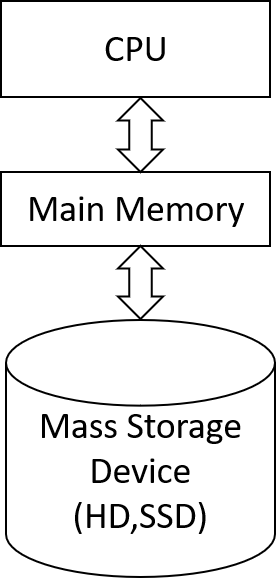
Data is stored on mass storage devices and loaded into the CPU's memory for processing.
It is crucial to comprehend that accessing the mass storage device is significantly slower than accessing the main memory. Additionally, accessing data already in one of the CPU caches is much faster than accessing the main memory.
Before processing data, the CPU requires it to be loaded into the primary memory.
The Teradata architecture consists of multiple interconnected computers.
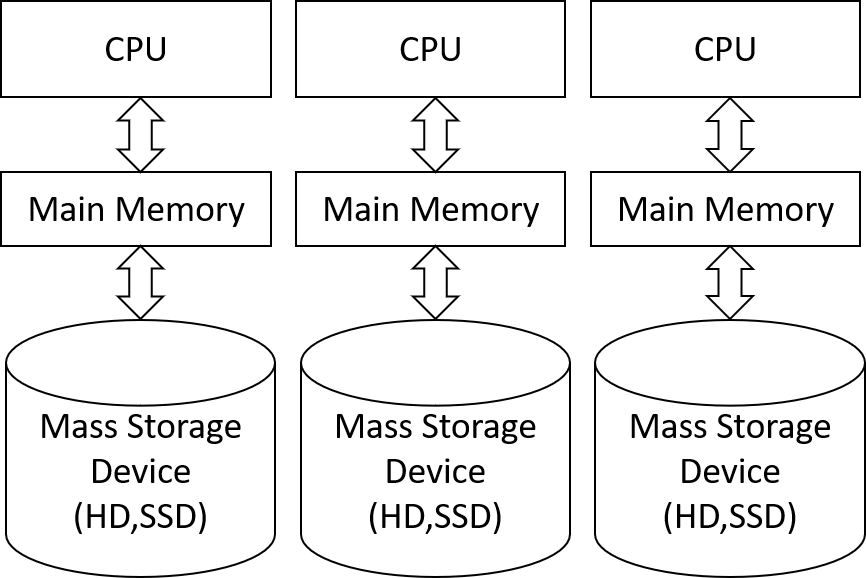
Teradata Data Distribution
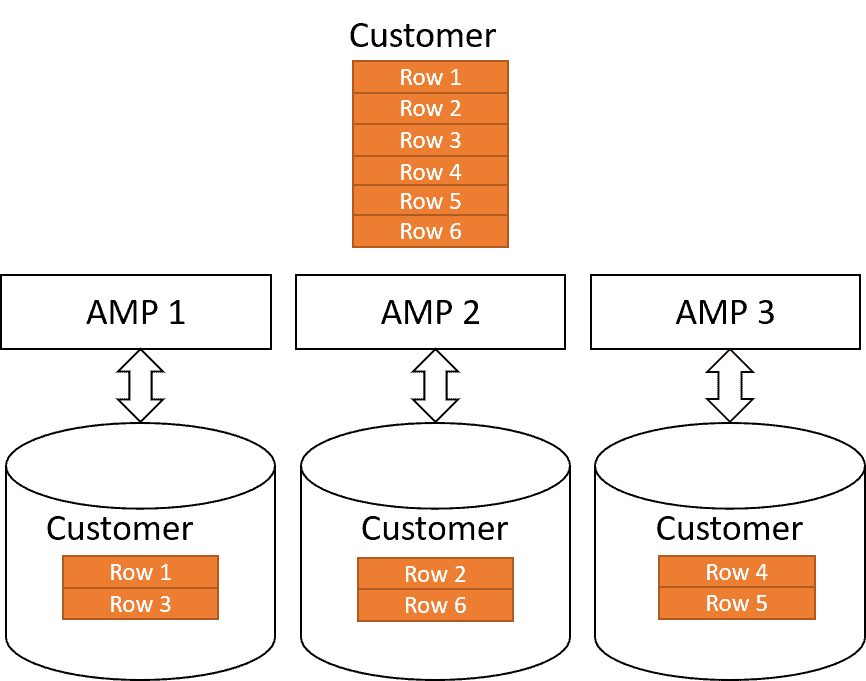
Teradata employs a hashing algorithm to evenly distribute table rows among AMPs responsible for executing the primary tasks. (Further details on AMPs will be discussed later in this article.)
The Parsing Engine
The Parsing Engine (PE) is a crucial component of the Teradata architecture.
The Parsing Engine generates an execution plan for all necessary AMPs upon receiving a request (such as an SQL statement) to complete that request. Ideally, the plan is structured to allow all AMPs to start and finish tasks simultaneously. This guarantees the best possible utilization of the system in parallel.
Get the next issue by email.
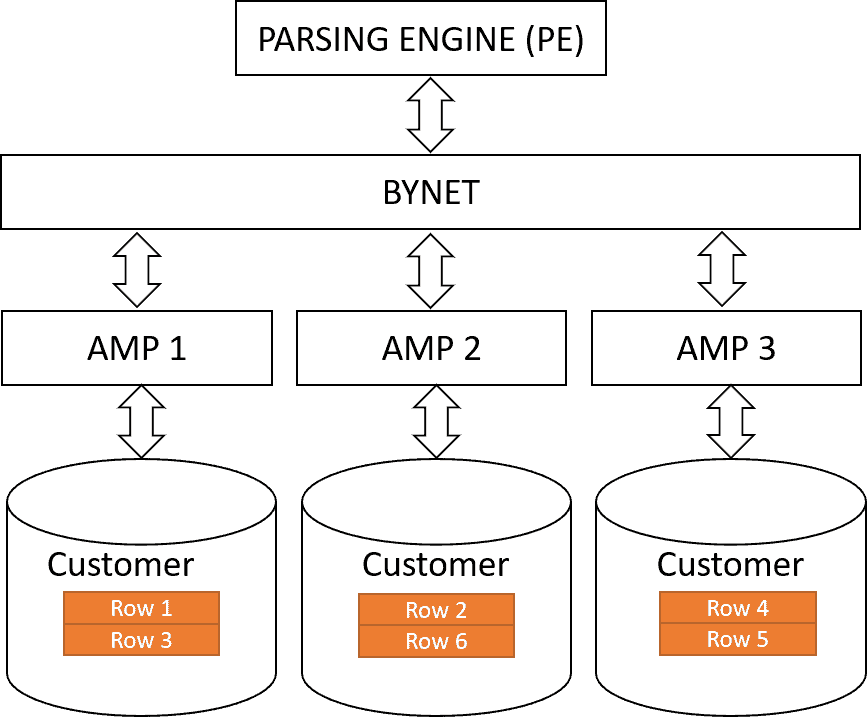
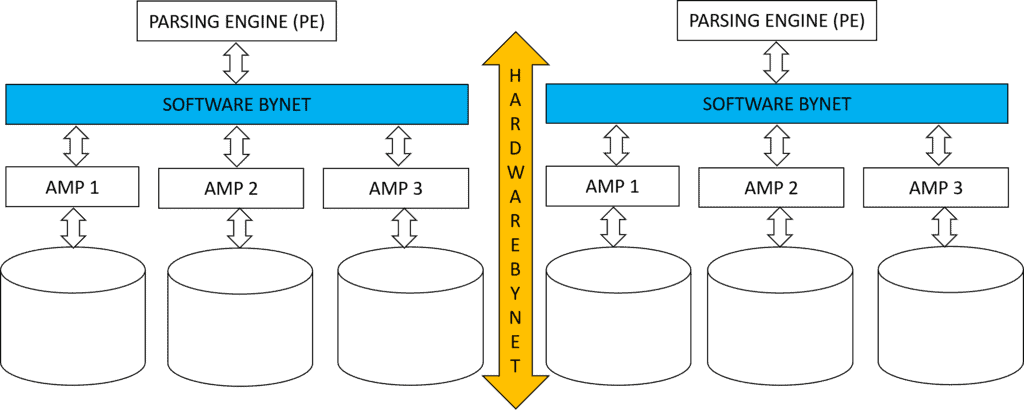
The figure above illustrates the position of the BYNET between the AMPs and the parsing engine, which facilitates the exchange of data and instructions via a communication network. Further explanation on BYNET will be provided later in this article.
The main responsibilities of the Parsing Engine include:
- Logging on and Logging Off Sessions
- The parsing of requests (syntax check, checking authorizations)
- Preparation and optimization of the execution plan
- The Parsing Engines use statistics to build an optimized plan.
- Controlling the AMPs by Instructions
- Communication with the client software
- EBCDIC to ASCII conversion in both directions
- Transfers of the result of a request to the client tool
Teradata Systems have the capability to utilize multiple parsing engines.
The system can add more parsing engines as each one has a finite capacity to handle sessions.
A parsing engine currently manages up to 120 sessions, which can be spread across multiple users or used entirely by a single user.
The Teradata AMP
AMPs are the primary agents in a Teradata System that execute instructions from the Parsing Engine, also known as the Execution Plan.
AMPs are autonomous entities with dedicated primary memory and storage resources.
Each AMP has exclusive access to its allocated resources.
The primary responsibilities of an AMP include:
- Storing and retrieving rows
- Sorting of rows (for details, read How Teradata sorts the result set)
- Aggregation of rows
- Joining of tables (see also: The Essential Teradata Join Methods)
- Locking of tables and rows
- Output conversion ASCII to EBCDIC (if the client is a mainframe)
- Management of its assigned space
- Sending of rows to the Parsing Engine or other AMPs (via the BYNET)
- Accounting
- Recovery handling
- Filesystem management
Each AMP can concurrently perform multiple tasks. Teradata has a default capacity to execute 80 parallel tasks.
The Teradata Node
Parsing engines and AMPs run on a node, typically a Linux machine with multiple physical CPUs.
Nodes have the capability to operate numerous AMPs, each with its own allocation of primary and virtual memory.
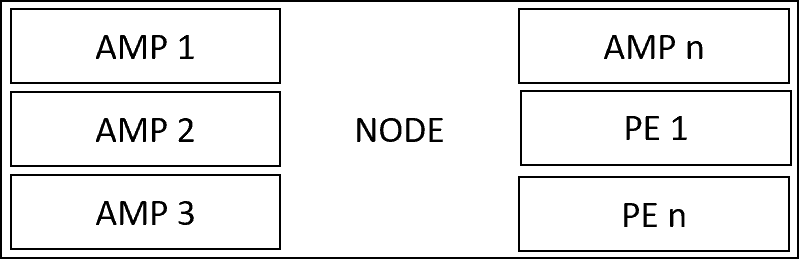
The nodes link to a disk array, and each AMP obtains a portion as a logical disk. The Teradata Intelligent Memory system controls this process, utilizing SSDs. Despite this, the fundamental concept remains unchanged.
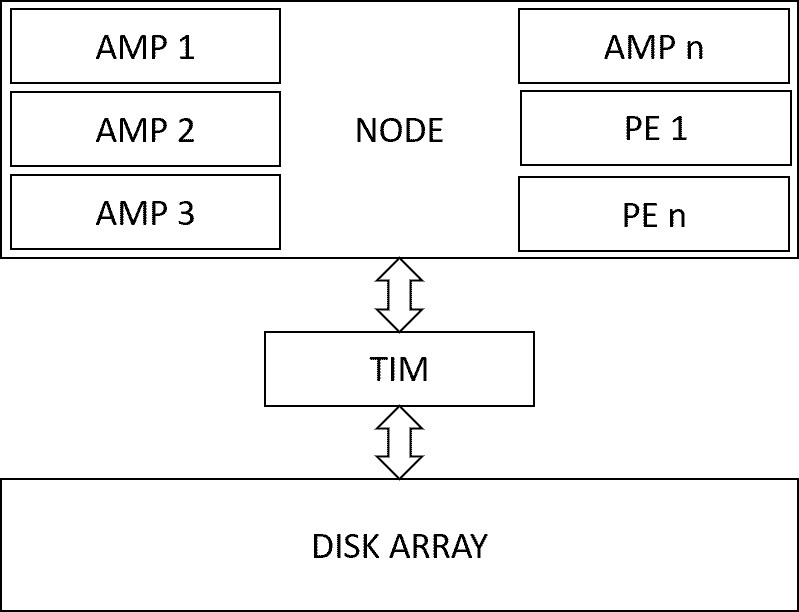
Massive Parallel Processing
A Teradata system comprises numerous nodes interconnected by BYNET.
The network within a node, known as BYNET, connects the AMPs to the parsing engine and to each other through software, in contrast to the physical network.
https://letters.dwhpro.com/content/files/2026/05/teradata-primary-index-pi-8.html See how Hashing is done on Teradata
Planning or surviving an enterprise data platform migration?
I write regularly about the performance, cost, architecture, and project mistakes that show up in real Teradata, Snowflake, Databricks, and enterprise data work.
Subscribe for free and keep launch access.
Written by Roland Wenzlofsky, founder of DWHPro and author of Teradata Query Performance Tuning. DWHPro has helped data warehouse practitioners for 15+ years.