A Brief History of Parallel Database Architectures and Their Limitations
Discover the history of parallel database architectures - from shared memory to shared disk and shared-nothing. Learn about the advantages and limitations of each architecture and how fault tolerance is handled. Explore the shift towards big data and the trend of "Hadoop over SQL."

The History of Parallel Database Architectures
Parallel computing has existed for over three decades, and parallel database architectures followed shortly thereafter.
It all began with the shared memory architecture, which remains widely used in servers today.
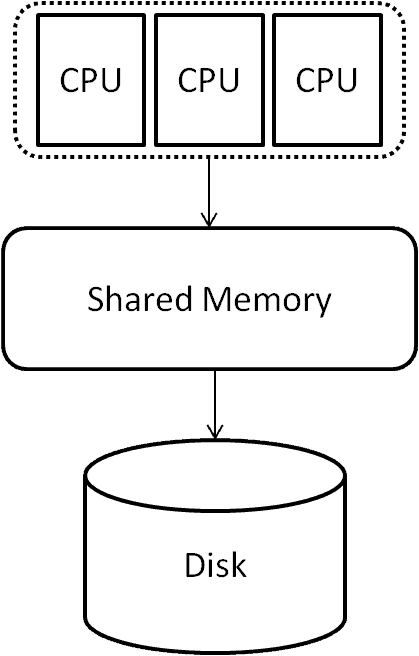
The shared memory architecture is a multiprocessor system with shared memory, a single operating system, and a shared disk or storage area network designated for data storage. The processes are distributed across the CPUs.
Want more practical data engineering analysis like this?
Join DWHPro Letters and get field-tested notes on Teradata, Snowflake, AI, migrations, performance, and enterprise data work. DWHPro Letters is free. Subscribe to get new issues by email.
The shared memory architecture lacks scalability, which limits the number of processors in a setup to a few hundred, even with modern multi-core processors.
Current databases use two architectures: shared disk and shared-nothing (Teradata is based on the latter).
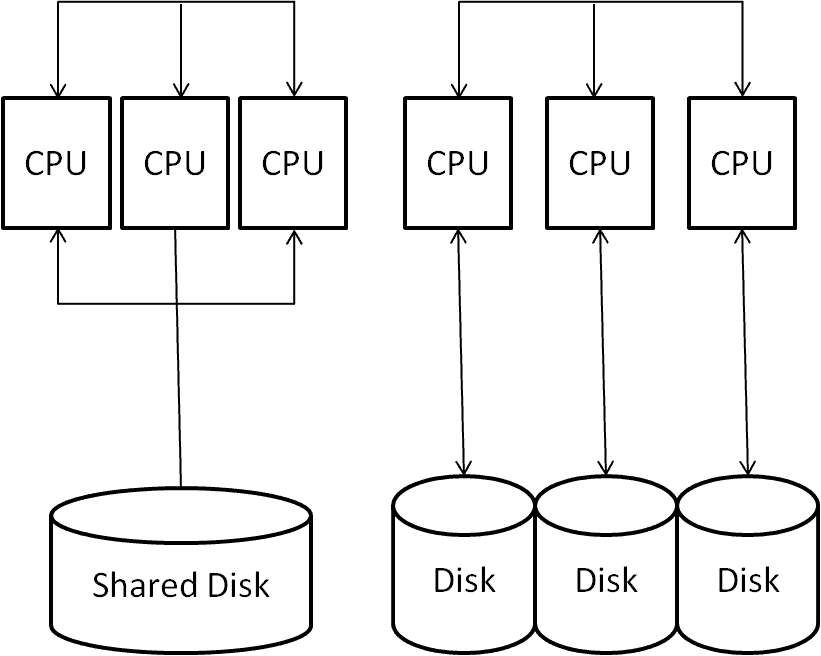
Both designs resolve the issue of limited scalability.
Shared disk architecture involves network-based communication among processors, storing data solely on a shared disk or a storage area network. This type of architecture comprises two distinct networks - one for inter-processor communication and another for communication with the disk storage system.
The shared-nothing design employs individual local disks for every processor, with processor communication exclusively reliant on the network.
Databases employing this architecture execute parallel queries, with data distributed across disks in a shared-nothing configuration.
Get the next issue by email.
Teradata experts can quickly identify the association between the shared-nothing configuration and the AMPs, storage units, and processor communication network known as BYNET.
A crucial objective of a database system with a shared-nothing architecture is to ensure equitable data distribution among the available disks. Teradata accomplishes this by hashing the primary index columns and storing the rows on the corresponding AMPs.
A database that utilizes a column-store approach distributes distinct columns across multiple disks. The objective remains consistent, which is to ensure equitable distribution of data to maximize parallelism efficiency.
Parallel databases and fault tolerance
Parallel databases are currently cutting-edge technology. However, fault tolerance remains a significant challenge for parallel databases, regardless of the underlying architecture.
Architectures perform well with a limited number of processors, as the likelihood of processor failure is minimal in such scenarios.
The probability of processor failure would be almost certain in a system with thousands of processors.
Parallel databases using one of the three described architectures are inherently non-fault-tolerant. To address this issue, Teradata, for instance, provides Hot Standby Nodes dedicated to replicating data across a network. Although costly, this is a commonly employed method, not exclusive to Teradata.
When comparing parallel databases to the Map-Reduce Framework (see related article for details), the parallel file system (HDFS) and fault handling stand out as a strong foundation for ensuring fault tolerance.
Batch operations are better suited for Map Reduce than parallel database systems like Teradata.
It is evident that major database vendors are now entering the realm of big data due to their unique architectural requirements.
The prevailing trend is to use "Hadoop over SQL" for a seamless transition, given that SQL is the predominant interaction language for most database systems.
It will be interesting to see how things develop. Teradata's proposal is SQL-H, while other database providers work on their own integrations. However, none of them have yet persuaded me.
Planning or surviving an enterprise data platform migration?
I write regularly about the performance, cost, architecture, and project mistakes that show up in real Teradata, Snowflake, Databricks, and enterprise data work.
Subscribe for free and keep launch access.
Written by Roland Wenzlofsky, founder of DWHPro and author of Teradata Query Performance Tuning. DWHPro has helped data warehouse practitioners for 15+ years.