The Apprenticeship That Vanished
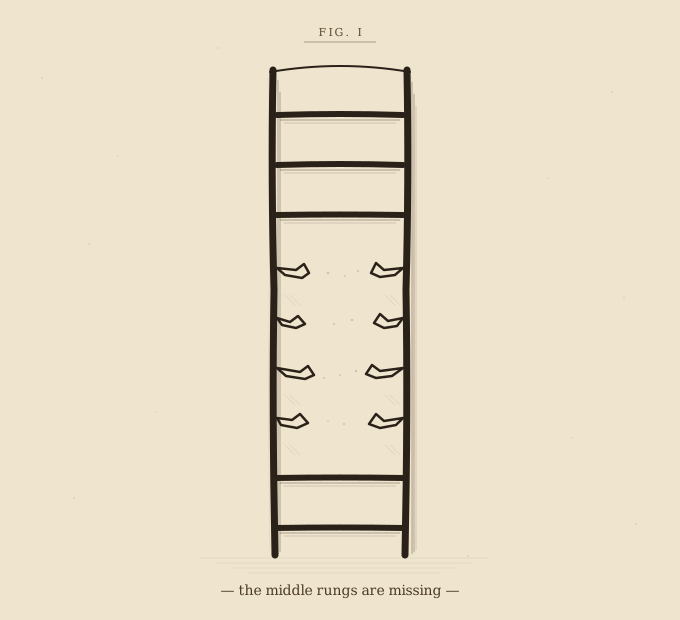
Banks are cutting junior data engineers today. The bill comes due in 2035.
The 2026 layoff numbers are real. Tens of thousands of tech workers lost their jobs in early 2026, with a disproportionate share hitting junior roles. The official narrative is that AI made these jobs redundant.
That narrative is half true. The other half is what nobody is saying out loud.
Want more practical data engineering analysis like this?
Join DWHPro Letters and get field-tested notes on Teradata, Snowflake, AI, migrations, performance, and enterprise data work. DWHPro Letters is free. Subscribe to get new issues by email.
Companies cutting juniors today are not saving money. They are deferring a cost—and deferring it onto the industry. The bill arrives between 2032 and 2040, when the senior cohort that built today's data infrastructure starts retiring, and there is no one well-trained enough to replace them.
Never-skilling, not deskilling
Researchers have a useful term for what is happening: never-skilling. Deskilling is when a practitioner loses a skill through disuse. Never-skilling is worse. It describes what happens when AI arrives before the foundational skill is built. The trainee never acquires the reasoning ability in the first place.
Data engineering is one of the more apprenticeship-shaped professions in software. You do not learn how a production warehouse actually behaves by reading documentation. You learn it by writing your first thousand SQL queries against real data, watching them fail, and developing the intuition for what "this looks wrong" feels like. You learn data modeling by maintaining somebody else's bad schema for two years until you understand why every shortcut they took causes a problem you now have to live with.
Every one of those experiences is exactly what AI now does in seconds. The senior who already has those reps does not need them anymore. The junior who has never done them never builds the underlying judgment.
Banking cannot fully automate this
Tech companies can cut juniors and let AI absorb the work. Banks cannot.
Every meaningful number a bank produces eventually has to be defended to a regulator. FATCA, CRS, and the EU AI Act, in full enforcement from August 2026, with penalties up to 7% of global revenue — every one of these regimes shares the same property. Not a LLM. A person. With a job title, a signature, and personal exposure if the number is wrong.
This is not a bug in the regulations. It is the central feature. When authorities audit a regulatory report, they are not auditing the AI that generated it. They are auditing the institution that submitted it, and the institution's defense rests on a chain of accountable humans who can each explain why their part of the calculation is correct. The AI cannot sit in that chair. It cannot be deposed. It cannot lose a banking license.
The practical consequence: banks cannot fully automate the senior tier. The work that builds those human years of grinding through reconciliations, fixing bad data, debugging production reporting failures, understanding why a legacy system was built the way it was — has to keep happening.
If you work with enterprise data platforms, migrations, performance tuning, or AI-driven delivery teams, DWHPro Letters is written for you. Get the next issue by email.
The five percent that is wrong
Take a real scenario. A tier-one bank runs a regulatory reporting system originally built on Teradata in 2003. The architecture reflects decisions that made sense at the time: specific primary index choices to manage skew, partition strategies because reporting windows were defined a certain way, and query bands set up because a regulator wanted specific traceability. None of those decisions is documented well. The people who made them have mostly retired.
Now somebody wants to migrate to Snowflake or Databricks. An LLM generates a migration plan in twenty minutes. The plan looks reasonable. It is probably ninety-five percent correct.
The five percent that is wrong is where the bank goes to the regulator with a number off by a few basis points, cannot explain why, and ends up in a multi-year remediation that costs more than the entire migration was supposed to save. Catching the five percent requires somebody who has lived with these systems long enough to know what to be suspicious of.
In 2026, this is a routine consulting engagement. A senior practitioner reads the AI's plan, points at three things, and says, "This is wrong, this is wrong, and this needs to be checked against the 2009 methodology document that lives on a shared drive somewhere." The bank pays a premium rate for that judgment because the alternative is a regulatory finding.
In 2036, the question is who has the equivalent judgment. The seniors will be retired. The juniors who would have replaced them are not being trained. The middle tier — the people in their mid-thirties who would normally be inheriting senior responsibility — is the cohort that should have been hired five years ago but wasn't.
The Y2K parallel
Most automation transitions worked out fine. ATMs did not eliminate bank tellers. Compilers did not eliminate programmers. The optimistic case rests on those parallels.
One historical analogy fits more directly: Y2K. In the late 1990s, the industry suddenly discovered it needed COBOL programmers it had stopped training in the 1980s. The few who remained were paid extraordinary rates to fix problems they were the only ones who understood.
The lesson is not that we should panic about a 2040 equivalent. The lesson is that capability gaps in deeply technical fields take decades to materialize and are extremely hard to close once they have formed.
What this means for banks
The practical implication is simple. Keep deliberately hiring juniors, even when AI tools could take over their work. Treat the apprenticeship cost as an investment, not as overhead. Banks that maintain serious junior pipelines through this period will have a structural advantage in the late 2030s, when everyone else discovers their pipelines are broken and tries to poach the same shrinking pool of experienced practitioners.
The other side of this is consulting. The premium for senior practitioners who can credibly sit in the accountability chair will not fall. It will rise because the cohort is thinning, and the demand is not.
The institutional answer
The question I keep coming back to is: who will be able to check whether the AI's output is correct? The technical answers are partial at best. AI checking AI catches some cases, but not the ones where models share training-data errors. Cryptographic verification proves the model produced the output, not that the output is right.
There is no technical answer that closes the gap. There is only an institutional answer: humans who were trained well enough to know.
Banks depend on a chain of trained human judgment. AI can accelerate that chain, automate parts of it, and augment the humans inside it. It cannot replace the chain. Somebody has to know what right looks like.
If we keep training those humans, the transition is uncomfortable but manageable. If we stop training them in the name of short-term margins, we will eventually find out the hard way what happens when nobody is left to sign for the answer.
I know which side of that I want to be on. Most of the industry is currently choosing the other side.
Want more field-tested data engineering notes?
DWHPro Letters covers enterprise data platforms, migrations, AI, performance, project economics, and the career side of technical work.
Subscribe for free and keep launch access.
Written by Roland Wenzlofsky, founder of DWHPro and author of Teradata Query Performance Tuning. DWHPro has helped data warehouse practitioners for 15+ years.